Walk, Don't Run gave The Ventures a No. 2 hit in 1960, yet the band did not write it.
A jazz guitarist named Johnny Smith composed the tune six years earlier.
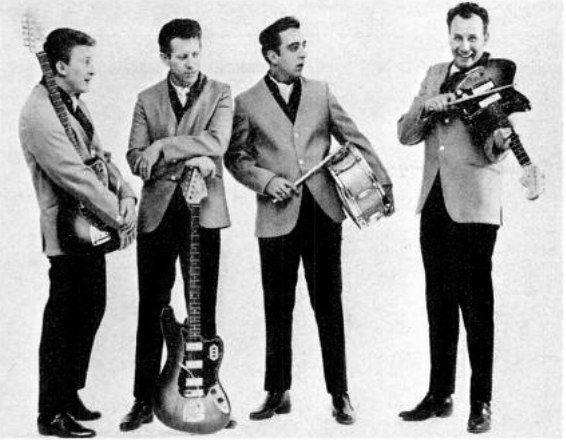
Table of Contents
- Where Did the Tune Come From?
- How Did The Ventures Record It?
- How High Did It Chart?
- The 1964 Remake and the Legacy
- FAQ
Where Did the Tune Come From?
A Jazz Guitar Contrafact
NPR reported that Smith wrote the piece while working as an NBC radio staff musician in New York.
According to Wikipedia, he built the melody on the chord pattern of "Softly, as in a Morning Sunrise" by Romberg and Hammerstein.
Smith put it on his 1954 album In a Sentimental Mood, under a title chosen by his producer, Teddy Reig.
How Chet Atkins Carried It Forward
Chet Atkins later recorded his own fingerstyle arrangement for the album Hi-Fi in Focus.
He talked it over with Smith first, and Smith was pleased with the result.
That arrangement, not Smith's original, became the basis for what The Ventures played.
How Did The Ventures Record Walk, Don't Run?
A Record Collection and a Seattle Basement
Bob Bogle owned the Atkins album and heard the tune on it.
The band cut the song with Bogle on lead guitar, Don Wilson on rhythm, Nokie Edwards on bass and Skip Moore on drums.
Joe Boles recorded it in the basement studio of his Seattle home.
The group pressed a batch of 45s and sent them to record companies.
Dolton Records released the single in spring 1960.
The Switched B-Side
The first pressing carried "Home" on the flip side.
After strong early sales, it gave way to a Bogle and Wilson original, "The McCoy," so the band's own writing could earn royalties.
The $25 Drummer
Moore was never a full-time member of the band.
For his session work he could take $25 or 25 percent of the single's royalties.
He took the $25.
How High Did It Chart?
The single peaked at No. 2 on the Billboard Hot 100.
Elvis Presley's "It's Now or Never" kept it out of the top spot.
It reached No. 3 on Cash Box for five weeks in August and September 1960.
It also hit No. 1 in Canada on August 29, 1960.
| Chart | Peak |
|---|---|
| Billboard Hot 100 (US) | No. 2 |
| Cash Box (US) | No. 3 |
| Hot R&B Sides (US) | No. 13 |
| Canada | No. 1 |
| UK Official Singles Chart | No. 8 |
The UK Run
The Official Charts Company lists a peak of No. 8 on the week of October 12, 1960.
It spent 13 weeks on that chart.
See the rest of that year in our 1960 year guide.
The 1964 Remake and the Legacy
A Second Hit From One Tune
The band recut the song in 1964 and added "'64" to the title.
Edwards now played lead and Bogle moved to bass.
The new version leaned toward the garage and surf rock sound of the day, with a lead guitar closer to "Misirlou."
It reached No. 8 on the Hot 100, and Wikipedia says the group was the first to score two top-10 hits with two versions of one tune.
The 1964 year guide shows what else crowded the charts that year.
Honors and Covers
Rolling Stone ranked the original No. 82 on its list of the 100 Greatest Guitar Songs of All Time.
Many artists have recorded it since, including these:
- The Shadows
- Glen Campbell
- Herb Alpert and the Tijuana Brass
Our Ventures biography follows the band from this hit to "Hawaii Five-O."
The tune also sits on our best 60s songs list.
FAQ
Who wrote Walk, Don't Run?
Jazz guitarist Johnny Smith wrote it in 1954.
The Ventures did not write it.
They adapted it after hearing a Chet Atkins recording.
How high did it chart for The Ventures?
It reached No. 2 on the Billboard Hot 100 in 1960, behind Elvis Presley's "It's Now or Never."
It also reached No. 8 in the UK.
Who played drums on the original single?
Wikipedia and the band's own website list Skip Moore.
He took $25 for the session instead of a share of royalties.
Did The Ventures record it twice?
Yes.
The 1964 remake reached No. 8 on the Hot 100.
Wikipedia says the band was the first to score two top-10 hits with two versions of the same tune.
Is it on Rolling Stone's list of great guitar songs?
Yes.
Rolling Stone ranked the Ventures' version No. 82 on its list of the 100 Greatest Guitar Songs of All Time, according to Wikipedia.
The story shows how a jazz idea can travel through a country record and end up on the pop charts, as Wikipedia's entry on the instrumental details.
Back to the 1960smusic.net homepage to explore every genre of the decade after hearing Walk, Don't Run.