Buck Owens was a Texas-born singer and guitarist who made Bakersfield, California, the loudest rival Nashville had in the 1960s.
With Don Rich and the Buckaroos, he scored 14 straight country No. 1 singles between 1963 and 1967.
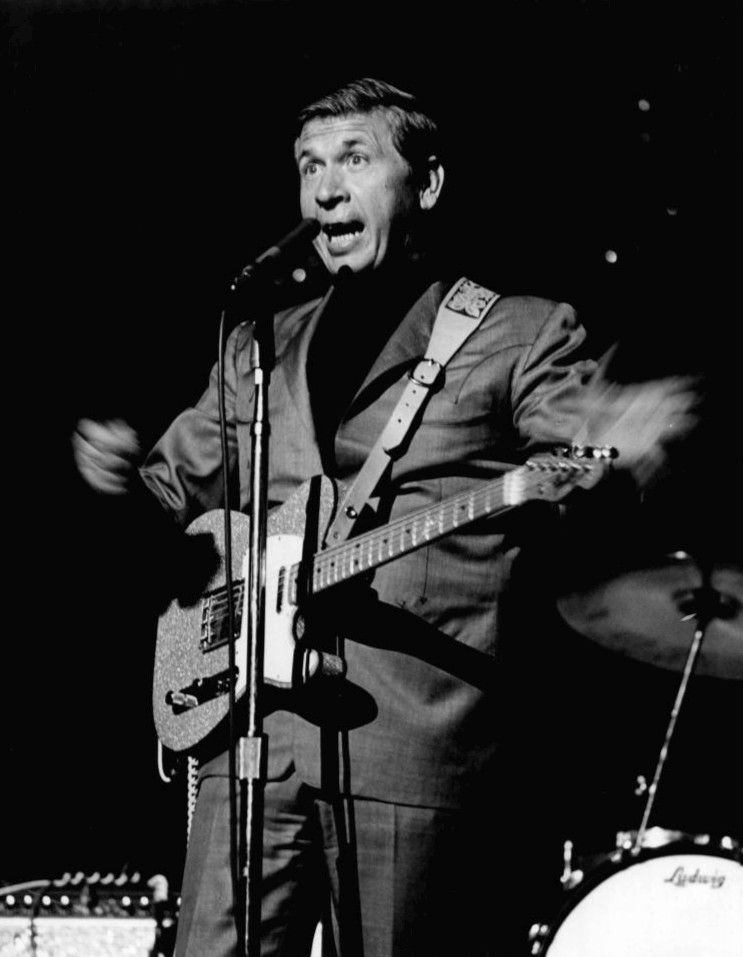
Table of Contents
- From Texas Cotton Fields to Bakersfield
- Session Guitarist to Capitol Star
- What Made the Bakersfield Sound
- Buck Owens and the Run of No. 1s
- Carnegie Hall, Japan and the White House
- Hee Haw and After the Sixties
- FAQ
From Texas Cotton Fields to Bakersfield
A Boy Named After a Donkey
Buck Owens was born Alvis Edgar Owens Jr. on August 12, 1929, on a farm near Sherman, Texas.
"Buck" was a donkey on the farm, and at three or four the boy announced that his name was Buck too.
In 1937 his sharecropping family fled the Dust Bowl for Mesa, Arizona.
Phoenix Honky-Tonks and the Road West
He taught himself several instruments and left school after ninth grade.
By 1945 he was co-hosting a radio show, Buck and Britt, and passing the hat in Phoenix bars.
Truck driving took him through Bakersfield, and in 1951 he settled there.
Session Guitarist to Capitol Star
Nights at the Blackboard
From 1951 to 1958 he played the Blackboard, a rough Bakersfield honky-tonk.
He also played guitar on Hollywood sessions for Tennessee Ernie Ford, Wanda Jackson and Tommy Collins.
He cut a rockabilly single, "Hot Dog," as Corky Jones.
Ken Nelson, Don Rich and the First Hits
Capitol producer Ken Nelson signed him in 1957.
In 1958, near Tacoma, Washington, he met a teenage fiddler named Don Rich.
"Second Fiddle" became his first chart record in 1959, and "Under Your Spell Again" reached No. 4.
Rich rejoined him in Bakersfield in December 1960.
What Made the Bakersfield Sound
Early 1960s Nashville meant strings and soft choirs.
Bakersfield records sounded like a dance hall on a Saturday night.
The Buckaroos' recipe was simple:
- Twin Fender Telecasters, picked hard and bright
- A loud, steady backbeat on the drums
- Tom Brumley's crying pedal steel
- High, tight two-part harmonies from Owens and Rich
Merle Haggard, who worked with Owens for a short spell in 1962, suggested the band's name.
The classic 1960s Buckaroos were Rich, bassist Doyle Holly, Brumley and drummer Willie Cantu.
In 1965 Owens bought a full-page ad in Music City News with a pledge that began, "I shall sing no song that is not a country song."
Buck Owens and the Run of No. 1s
Act Naturally Starts It
Johnny Russell's "Act Naturally" was pitched to him in early 1963, and he did not like it.
Rich talked him into recording it on February 12.
On June 15, 1963, it gave him his first country No. 1.
His own "Love's Gonna Live Here" followed and held the top spot for 16 weeks.
In 1965 The Beatles covered "Act Naturally," with Ringo Starr singing lead.
Together Again and a Tiger in the Tank
In 1964 "My Heart Skips a Beat" went to No. 1, and its B-side knocked it off the top.
That flip, "Together Again," carries Brumley's best-known steel solo.
Owens wrote "I've Got a Tiger by the Tail" with Harlan Howard after seeing Esso's "Put a tiger in your tank" slogan.
It spent five weeks at No. 1 in 1965 and reached No. 25 on the Hot 100, his biggest pop hit.
Later that year the instrumental "Buckaroo" topped the country chart too.
The Byrds later played it live at the Fillmore in 1969.
Press Play on any row to hear the single.
| Play | ||||
|---|---|---|---|---|
| "Above and Beyond" | 1960 | No. 3 | — | |
| "Foolin' Around" | 1961 | No. 2 | — | |
| "Under the Influence of Love" | 1961 | No. 2 | — | |
| "Act Naturally" | 1963 | No. 1 | — | |
| "Love's Gonna Live Here" | 1963 | No. 1 | — | |
| "My Heart Skips a Beat" | 1964 | No. 1 | No. 94 | |
| "Together Again" | 1964 | No. 1 | — | |
| "I Don't Care (Just as Long as You Love Me)" | 1964 | No. 1 | No. 92 | |
| "I've Got a Tiger by the Tail" | 1964 | No. 1 | No. 25 | |
| "Before You Go" | 1965 | No. 1 | No. 83 | |
| "Buckaroo" | 1965 | No. 1 | No. 60 | |
| "Waitin' in Your Welfare Line" | 1966 | No. 1 | No. 57 | |
| "Think of Me" | 1966 | No. 1 | No. 74 | |
| "Sam's Place" | 1967 | No. 1 | No. 92 | |
| "How Long Will My Baby Be Gone" | 1968 | No. 1 | — | |
| "Who's Gonna Mow Your Grass" | 1969 | No. 1 | — |
Peaks are from Billboard's chart history; a dash means the single missed the Hot 100.
The Streak Runs to 1967
From "Act Naturally" through "Your Tender Loving Care" in 1967, 14 of his solo singles in a row went to No. 1.
"It Takes People Like You (To Make People Like Me)" finally broke the run at No. 2.
Carnegie Hall, Japan and the White House
A Country Band in New York
On March 25, 1966, the Buckaroos became only the second country band to play Carnegie Hall.
Capitol released the show that July as Carnegie Hall Concert.
Ray Charles took his own versions of Owens' "Crying Time" and "Together Again" onto the pop charts in 1966.
In 2013 the Library of Congress added the concert album to the National Recording Registry.
Taking Bakersfield Abroad
In 1967 the band toured Japan, a rare trip for a country act, and released a live album from it.
In 1968 they played the White House for President Lyndon Johnson.
"Who's Gonna Mow Your Grass" and "Tall Dark Stranger" both reached No. 1 in 1969.
Hee Haw and After the Sixties
Hee Haw premiered on CBS on June 15, 1969, with Owens and Roy Clark as hosts.
He stayed until 1986.
On July 17, 1974, Don Rich died in a motorcycle crash near Morro Bay.
Owens later said his music life ended that day.
Dwight Yoakam coaxed him back for "Streets of Bakersfield," a country No. 1 in 1988.
The Country Music Hall of Fame inducted him in 1996.
He died at his ranch north of Bakersfield on March 25, 2006.
Meet his Nashville rivals in our 1960s country music hub.
His peak years ran from 1963 to 1966.
FAQ
What was Buck Owens' most famous song?
"Act Naturally" is the best known, thanks to the Beatles' 1965 cover.
"I've Got a Tiger by the Tail" was his biggest pop hit, reaching No. 25 on the Hot 100.
How many number one hits did Buck Owens have?
He and the Buckaroos had 21 No. 1 hits on Billboard's country chart.
Who were the Buckaroos?
Don Rich, Doyle Holly, Tom Brumley and Willie Cantu made up the classic 1960s lineup.
Who was Buck Owens' first wife?
Singer Bonnie Campbell, whom he married in 1948.
They separated in 1951, and she later married Merle Haggard.
When did Buck Owens die?
He died on March 25, 2006, at his ranch just north of Bakersfield, aged 76.
The full life story is in Wikipedia's entry.
Start with "Act Naturally," then put on Carnegie Hall Concert to hear why Buck Owens still sounds like Saturday night.