Bob Dylan arrived in Greenwich Village in January 1961 as a Minnesota kid with a guitar and a harmonica rack.
By 1966 he had written the protest anthems of the folk revival, then plugged in and rewrote the rules of rock.
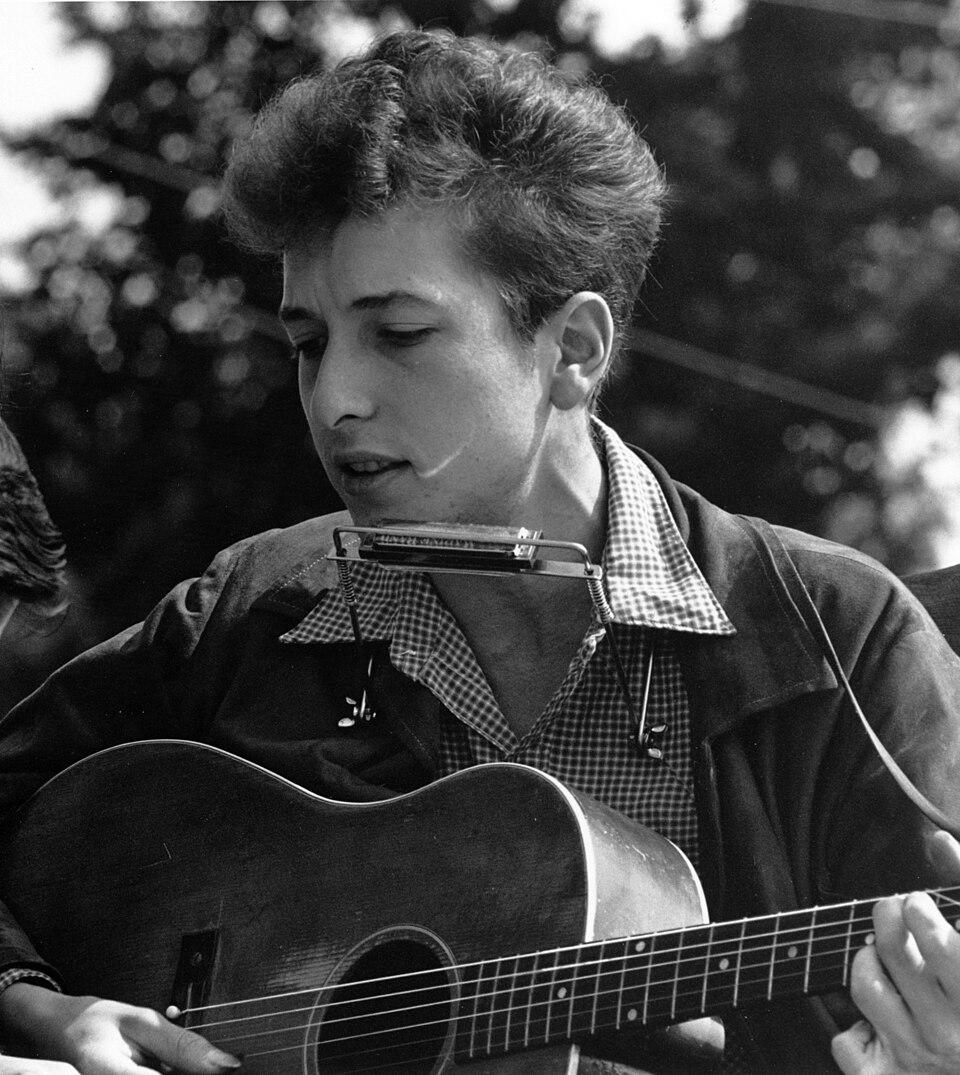
Table of Contents
- How Bob Dylan Reached Greenwich Village
- Protest Songs and the Folk Revival
- Going Electric: Newport and Like a Rolling Stone
- Blonde on Blonde, Judas and the Motorcycle Crash
- Legacy and Honors
- FAQ
How Bob Dylan Reached Greenwich Village
He was born Robert Allen Zimmerman on May 24, 1941, in Duluth, Minnesota.
The family later moved to Hibbing, where he grew up on Elvis Presley, Jerry Lee Lewis and Little Richard.
He left for New York in January 1961.
Woody Guthrie and the Columbia Contract
In New York he sought out the hospitalized Woody Guthrie and wrote "Song to Woody" for him.
He played Greenwich Village clubs through 1961 and won a warm New York Times review.
That September he played harmonica on a Carolyn Hester session for Columbia Records.
Producer John Hammond signed him to the label that October.
His self-titled debut arrived on March 19, 1962, and sold only about 5,000 copies in its first year.
On August 9, 1962, he made the new name legal at the St. Louis County Court in Hibbing.
Protest Songs and the Folk Revival
The Freewheelin' Bob Dylan came out on May 27, 1963.
It reached number one in the UK and number 22 in the US.
Its opening track, "Blowin' in the Wind," became an anthem of the civil rights movement.
On August 28, 1963, he sang at the March on Washington.
Joan Baez shared the stage with him that year.
The Times They Are a-Changin' and Another Side
The title song of his 1964 album, The Times They Are a-Changin', became a generational slogan.
The album reached number 20 in the US and number four in the UK.
Another Side of Bob Dylan followed that August.
It turned from topical protest toward personal, surreal writing.
Going Electric: Newport and Like a Rolling Stone
Bringing It All Back Home arrived in spring 1965, recorded that January with Tom Wilson producing.
Side one was electric, side two acoustic.
"Subterranean Homesick Blues" gave him his first US chart entry at number 39.
The album reached number six in the US and number one in the UK.
The Rock and Roll Hall of Fame credits his work with The Beatles as part of that influence.
The Newport Folk Festival, July 25, 1965
On July 25, 1965, he played an electric set at Newport backed by members of the Paul Butterfield Blues Band.
It was his first public performance of "Like a Rolling Stone."
Some fans booed, and folk purists including Pete Seeger objected.
Eyewitness accounts describe much of the crowd as enthusiastic, and the exact cause of the noise is still debated.
The same year, The Byrds scored with an electric cover of "Mr. Tambourine Man," and the folk rock sound took off.
Like a Rolling Stone and Highway 61 Revisited
"Like a Rolling Stone" was cut on June 15 and 16, 1965, at Columbia's Studio A in New York.
On day two, 21-year-old session guest Al Kooper improvised a Hammond organ part that Dylan insisted on keeping loud.
Released on July 20, it ran 6:13, far past the three-minute single norm.
It peaked at number two in the US, held off the top by The Beatles' "Help!"
Rolling Stone later ranked it number one on its 2004 list of the greatest songs.
Highway 61 Revisited followed on August 30, 1965, and reached number three in the US.
The single "Positively 4th Street" came out between that album and Blonde on Blonde.
Blonde on Blonde, Judas and the Motorcycle Crash
Blonde on Blonde came out on June 20, 1966, as a double album on Columbia.
Producer Bob Johnston recorded much of it in Nashville with Charlie McCoy and Kenny Buttrey.
"Rainy Day Women #12 & 35" reached number two on the Hot 100.
Together with the two 1965 records, it completes the trilogy that defined 60s rock at its most literate.
Judas in Manchester
Earlier that spring he toured Britain with an electric band.
At Manchester's Free Trade Hall on May 17, 1966, an audience member shouted "Judas!"
The Crash and the Basement Tapes
On July 29, 1966, he crashed a motorcycle near Woodstock, New York, and withdrew from the road.
In 1967 he recorded more than 100 songs at home with the musicians who became The Band.
John Wesley Harding followed on December 27, 1967, reaching number two in the US and number one in the UK.
The country-tinged Nashville Skyline arrived on April 9, 1969, and "Lay Lady Lay" hit number seven.
| Album | Released | US peak | UK peak |
|---|---|---|---|
| Debut (self-titled) | March 1962 | Did not chart | 13 |
| The Freewheelin' | May 1963 | 22 | 1 |
| The Times They Are a-Changin' | 1964 | 20 | 4 |
| Another Side | August 1964 | 43 | 8 |
| Bringing It All Back Home | 1965 | 6 | 1 |
| Highway 61 Revisited | August 1965 | 3 | 4 |
| Blonde on Blonde | June 1966 | 9 | 3 |
| John Wesley Harding | December 1967 | 2 | 1 |
| Nashville Skyline | April 1969 | 3 | 1 |
Legacy and Honors
The Rock and Roll Hall of Fame inducted him in 1988, with Bruce Springsteen delivering the speech.
He received a Pulitzer Prize special citation in 2008 and the Presidential Medal of Freedom in 2012.
In 2016 the Swedish Academy gave him the Nobel Prize in Literature.
Its citation praised him "for having created new poetic expressions within the great American song tradition."
His 1960s run showed that a pop single could carry long, literate lyrics.
The pivotal year was 1965.
FAQ
Why did Bob Dylan go electric?
He had grown up on rock and roll and wanted a band behind him.
He recorded electric tracks in January 1965, then played an electric set at Newport on July 25, 1965.
What happened in Dylan's 1966 motorcycle accident?
Dylan crashed his motorcycle near Woodstock, New York, on July 29, 1966, and withdrew from touring.
The details have never been fully clear, since no ambulance was reported.
What was Bob Dylan's biggest hit of the 1960s?
Both "Like a Rolling Stone" in 1965 and "Rainy Day Women #12 & 35" in 1966 peaked at number two on the Billboard Hot 100.
Rolling Stone ranked the first one number one on its 2004 list of the greatest songs.
Did Dylan win the Nobel Prize?
Yes.
The Swedish Academy awarded Dylan the 2016 Nobel Prize in Literature "for having created new poetic expressions within the great American song tradition."
He was the first American winner since Toni Morrison in 1993.
Few artists changed popular music as completely, and as fast, as this one did between 1961 and 1966.
The long story, including his later decades, is covered on Wikipedia's Bob Dylan biography.
Back to the 1960smusic.net homepage to explore every genre of the decade.